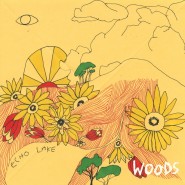
 Woods
WoodsAt Echo Lake
Score: 23
Brooklyn indie-folk group Woods, formed in 2005, released their fifth album, At Echo Lake, on the 4th. Like Woods’ earlier work, At Echo Lake combines the folk base of the band’s music with psych-rock to create the band’s own brand of psych-folk. However, though there’s plenty of potential in that particular blend, At Echo Lake has far too many flaws to bring everything together in a way that does it justice.
Instrumentally, At Echo Lake switches between the jam-band sound of “Blood Dries Darker” and the more elegant folk sound of “Death Rattles,” attempting to mix the larger soundscape of that former style with the folksy sound of Jeremy Earl’s guitar. Unfortunately, the styles end up doing more in the way of colliding than they do combining. Largely thanks to this split approach to thematics, much of the album seems far noisier than it should, shadowing out the more successful parts of the album - for example, on “Mornin’ Time,” where the discordant noise that initially floats through the background of the track is effectively mashed into the main body of the music, resulting in a track that, by the end, has become entirely cluttered. The lo-fi sections that crop up throughout the album certainly don’t help this, as, without careful positioning among the sound as a whole, they do little but introduce static that further exacerbates the confusion.
Earl’s quite high tones might, with a good bit less unnecessary emphasis, work well with Woods’ diverse sound. However, as it is, he instead seems to whining his way through At Echo Lake, such that his voice adds a fairly unpleasant sharp sound to already lacking music. It doesn’t help that much of the album’s vocals have been put through a filter that succeeds only at making them sound worse, simultaneously hollow and in an even more acute whine than the unmodified sections. This would perhaps have been excusable as a temporary experiment - but when it sticks around for most of the album, it’s just not a good idea.
Unfortunately, At Echo Lake isn’t saved by great writing. Instead, it’s largely filled with repetition and largely nonsensical quasi-poetic lines, such as “Death rattles in torn-up shoes / Love lies in the cut-up roots / The painter survives just to be by your side,” from “Death Rattles.” Given that the rest of the album is certainly less-than-mediocre, this can’t hurt it that much, but it certainly does reinforce the album’s greater failings.
At Echo Lake is, quite simply, not a good album. There are good bits here and there - the most folk-inspired moments of the music, when they stick up, are solid, and some of the noise-imbued sections are interesting - but for the most part, too many things are wrong with the album for it to come near success. It would be much easier to blame At Echo Lake’s many issues on misguided experimentation were the issues not so widespread, but as it is, At Echo Lake is inexcusably weak.