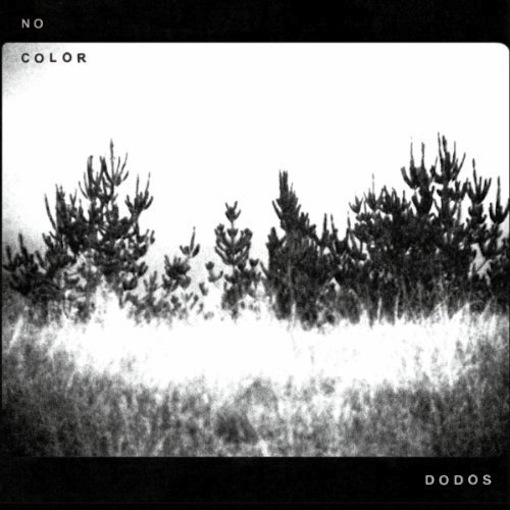
 The Dodos
No Color
Score: 71
San Francisco indie group The Dodos was formed in 2005 as Dodo Bird. Six years, one name change, and three LPs later (one critically acclaimed, one less so, and one too early to be noticed), the band released its newest album, No Color. No Color is an evolution from Time to Die’s mixed success into a more careful sound for The Dodos. It’s not an entirely successful evolution, but it is one that leaves us with an often intriguing album.
Meric Long’s voice, which often seems in possession of an almost conversational tone, falls into a very regular pattern through No Color. This makes for a clear sound that certainly accents the album’s instrumentals, but which at the same time is almost entirely predictable. Is that a fair tradeoff? Well, that depends on whether it’s better to have variety or concordance. In this case, since The Dodos occasionally suffer from issues with repetition, it might have been better to lean towards variety - but that doesn’t make Long’s approach a failure. Instead, it simply prevents it from working as well as it could have, and Neko Case’s contributions, as well as vocal accents such as “Black Night“ ‘s yelps, go a ways towards keeping everything interesting.
Lyrical depth is not one of The Dodos’ strengths. Instead, they tend to better at wielding imagery and the sound of words than actual meaning. Lines like “This takes us by surprise, I’m sure / Are you the curse? / Are you the cure?” sound interesting, but don’t really go anywhere - although that’s not really the point. To a large extent, they’re there to augment the band’s sound. Especially with the oft-repeated hooks, the point of No Color’s lyrics seems to be more to create a general feeling about the album then to tell stories.
General theory for any sort of performance or production states that only the first and last bit make any sort of major impression on the observer. Whether or not that is true for an album, it is interesting to note that No Color begins with (albeit fairly successful) almost excruciatingly heavy drumming, transitioning into a unique and beautifully complex, if harsh, guitar line. The track as a whole works shockingly well - and transitions quite well into the subsequent track - fully validating the interesting choice of percussion.
Similarly interesting is the final track of the album. In fact, of the entire album, the last track most closely resembles the first in musical complexity - at least of the guitar line. Throughout the album, The Dodos maintained a high level of activity, depth, and individuality, but the beginning and end of the album are clearly the high points. In some sense, the track should be praised, individually, for its merit, but its similarity to the first track makes it somehow less desirable.
If No Color were, as well as a deep album, a heavily diverse album, it would make a recapitulation of the opening track more than pleasant, adding welcome symmetry to the album. But The Dodos never really stray far from their original concepts. More than one track has heavy yet appropriate drumming, and the similarities between tracks by no means stops there. Given that, the final track is fairly inappropriate, lacking much originality. No Color is an interesting album. While ‘pleasant’ may not be the best descriptor, it is certainly enjoyable in its own, fairly potent way.
Merely “enjoyable in its own, fairly potent way,” and you awarded it a 71? I come away a bit confused as to whether or not you’re recommending the album! I bought “Time to Die” off a merch table after seeing them live (opening for the New Pornographers), and barely recognized the songs in album form; the band’s stage performance added a tremendous energy that was woefully missing from the LP. Nonetheless, I’ve come to enjoy it as innovative for its guitar-as-percussion aesthetic. Might this album, also, be a grower?