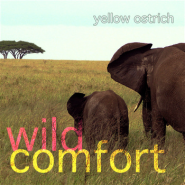
 Yellow Ostrich
Wild Comfort
Score: 81
Welcome back to Plumbiferous, and happy New Year! Our first album of 2010 is, quite fittingly, from the solo project of Alex Schaaf, frontman of The Chairs, skilled creators of our 2009 top album, Nine Ways. Schaaf’s newest album, Wild Comfort, third to be released under the name Yellow Ostrich, is simultaneously more electronic and simpler than any of Schaaf work with The Chairs - and therefore enjoyable in its own way.
Without the musical contribution of other Chairs members, Schaff’s work has definitely taken a turn towards simplicity, as well as electronica. While there are certainly still segments of pure cacophony, they’re developed from few, relatively simple lines which are then heavily layered. The most complicated the album gets is maybe two or three synth/electric guitar lines plus a rather simple percussion track, and between one and three vocal lines, and the album more than once relies on a single fragmented synth line accompanying only one layering of Schaff’s voice (the album is, in general, quite layered as far as vocals are concerned). Wild Comfort therefore, relies much more on Schaff’s knack for innovative and absolutely unique ideas than complexity and density of any sort. And while this certainly results in less emotionally compelling instrumentals, it also creates amazing sections like the (perhaps overextended) last part of the opening track, which begins with an unexpected chord change and quickly moves into vocal layering over a simple but highly effective instrumental section.
Schaaf’s vocal style is clearly just as strong solo as accompanied by the orchestral might of The Chairs, which serves him quite well throughout Wild Comfort. Schaaf’s voice generally meshes excellently with the remarkably synthy sound of the album, especially on tracks such as “Run Monster Run,” where the intriguing ebb and flow of his vocal style is best displayed. On top of this, Schaaf employs vocal harmony expertly, creating a rich, layered sound. However, at certain points on Wild Comfort, Schaaf’s voice seems oddly subdued, as if it’s been placed a bit too far under the music. Nevertheless, for the most part Schaaf’s voice works quite well with the music as a whole.
History has shown Alex Schaaf’s tendency towards vivid storytelling in his music, and Wild Comfort is no disappointment. Though Wild Comfort relies somewhat more heavily on repetition that much of Schaaf’s work, it also includes several excellent tales, most notably “Dmitri’s Foxes,” told from the perspective of Russian scientist Dmitri Belyaev’s domesticated foxes. Schaaf sings “You bred out fear,” and then bids his audience farewell on Wild Comfort’s closing track, “ ‘Til I Disappear.” Wild Comfort is, in the stories it tells, eminently entertaining.
Unfortunately, there are problems with Wild Comfort. In contrast to Schaff’s work with The Chairs, which sounded absolutely engrossing and immersive regardless of whether it was recorded in a studio or a dorm room, Wild Comfort simply doesn’t sound, from a technical standpoint, all that amazing. Sometimes lines will sound perfectly decent, and sometimes they (and this especially effects the percussion) sound as if they were made with low quality keyboard patches. Additionally, there are some tracks that are all too repetitive or boring. “Spider,” by far the worst of the bunch, will convince you that someone is trying to pound a dull nail into the back of your neck.
Wild Comfort is a generally strong album that suffers from some, perhaps inescapable flaws. The vocals are clearly what makes the album work, meaning that the sections devoid of vocals often drag or just get annoying. Then there are a few tracks that are so experimental that they simply grow tiresome, for example, the majority of “Run Monster Run,” and finally there are the tracks that are mediocre for the most part and rely on one or two crystallizing moments, generally near the end of the track, that intend to make the whole track worthwhile, and only somewhat manage to do so. But even among all this, one cannot escape the feeling that Alex Schaff is simply a musical genius, and more importantly, a musical genius that is also a terrific singer. Wild Comfort has its highs and lows, many of which are intentional, and whether individual bits work or not, the album as a whole certainly leaves the listener on an overall high note.
This post is tagged 80-89, Yellow Ostrich