 Sunset
Gold Dissolves to Gray
Score: 51
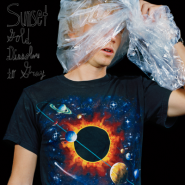
Sunset, hailing from Austin, Texas, has been quite rapidly releasing albums, the newest of which is Gold Dissolves to Gray. The band, probably best described as “indie experimental folk-pop,” has with Gold Dissolves to Gray provided a whirlwind tour of the furthest possible stretches of its genre, from a cover of the classic, once-reggae, “Rivers of Babylon” to the more electronically-influenced “So Long Farewell Adieu.” Unfortunately Gold Dissolves to Gray, while certainly not bad in the slightest, is simply neither terribly interesting nor anything incredible. Gold Dissolves to Gray is, for the most part, just about mediocre.
Gold Dissolves to Gray opens with a purely instrumental track. Highly promising, it takes a simple, catchy chord progression and maps it to an odd rhythm, with the final product being an interesting, active, and still very much accessible track. Unfortunately, what follows in its wake is nothing like the introductory track. Even on “Green Truck,” which quite clearly harkens back to the first track, no interesting rhythms are to be found, and much of the activity is lost.
Other tracks like “Fishtown” certainly have their own merit - “Fishtown” with its infectious bass and airy vocals that somehow manage to fit in with the rich instrumentals, as well as, say, “Garden of Eden” (instrumentals that are simple, but nonetheless tailor-made to fit the vocal style), and the instrumental conclusion of “Our Dreams Did Weave a Shade” (in the creative descending chords and an even more creative echoing dual-line guitar solo that follows). Still, it’s hard to shake the feeling that most of the album is not much more than a letdown. “Sunshine Hair” opens with a potentially interesting guitar line that then dissolves into static nothingness, occasionally punctuated by strains of the original guitar line that somehow manage to seep through the instrumental smog. Additionally, much of the latter part of the album, especially from “Civil War” onwards, when not downright disappointing, is simply dull, and acts as little more than filler material.
Bill Baird’s vocals don’t enter Gold Dissolves to Gray until after the first track of the album, “Change Comes Slow,” but once they do, they help to develop each of the distinct styles that appear throughout the album. Slowly emerging through “Sunshine Hair,” where they serve as a somewhat subdued presence, into the familiar folk-styled cover of “Rivers of Babylon,” and finally into the hilarious “Garden of Eden,” where Baird uses his voice in a manner that most closely approaches a rhythmic sort of spoken word, Baird’s voice opens the album, introducing the variety of influences found throughout Gold Dissolves to Gray. Generally, the album works well vocally, though missteps in mixing or overall sound occasionally crop up.
For the majority of Gold Dissolves to Gray, while Baird’s vocals are well-mixed into the music in whatever direction it’s currently headed, the lyrics are largely lost among the rest of the sound. A few exceptions through the album, however, provide genuinely amusing or interesting lyrics. The best example is the early track “Garden of Eden” which chronicles the development of mankind, beginning with: “Well once upon a time / Mankind was all just a bunch of apes / We all had furs / And we all ate steaks,” and progressing onto the Garden of Eden. Before beginning the final lines of the chorus, Baird laments “And as for me, I’d like to be an ape again / But I’m allergic to steak / And my beard’s too thin.” It all makes for quite an amusing effect - especially when followed by a track titled “Fishtown.” Later on the album, “Hill Country Smog” has much the same appeal with the repeated lines “Hill country smog / I can’t breathe!”
Gold Dissolves to Gray begins relatively well with the musically interesting “Change Comes Slow,” but quickly begins the fluctuation in quality that plagues the album. The innovation of the first track is never seen again, and though several tracks (including “Garden of Eden” and “Hill Country Smog”) are interesting simply due to their lyrics, the album becomes regrettably stagnant surprisingly quickly. Gold Dissolves to Gray is mostly solid musically, but it’s simply not interesting enough to sustain itself through its entire length.